Regulation
France's cold-calling ban, two months on: why illegal calls haven't gone away
Since 11 August 2026, calling a consumer in France to sell them something without their prior consent is banned. The law was meant to end unwanted sales calls. Two months on, the picture is more mixed: illegal calls have not disappeared, and companies that outsource outbound calling are more exposed than ever.
What changed on 11 August 2026
The logic has been reversed. Consumers used to register with Bloctel, France's do-not-call list, to stop calls. Now companies must obtain consent before calling.
- Consent must be explicit, informed and revocable at any time. It is valid for one year, and you cannot call someone to ask for it.
- Proof of consent must be kept for three years.
- Calling hours are limited to Monday to Friday, 10am–1pm and 2pm–8pm, with a maximum of 4 calls per month to the same consumer.
- Some sectors are banned from cold calling altogether: energy renovation, home adaptation for disability or old age, and personal training accounts (CPF).
- Exceptions: calls about an existing contract, newspaper and magazine subscriptions, and calls within 5 working days of a quote request.
- Penalties reach €75,000 for an individual and €375,000 for a company.
The figures: complaints have doubled
On SignalConso, the French consumer authority's reporting platform, there were 64,000 complaints about abusive cold calls between 1 January and 10 August 2026, around 290 a day. Since the law took effect, the pace has doubled: 16,000 complaints in the first month, then 26,000 in about six weeks, close to 580 a day.
These figures need care. A complaint is not a call: the closure of Bloctel has channelled complaints to SignalConso, and media coverage of the law has encouraged people to report. But they certainly show no decline. On 1 October, a French senator told the government that unsolicited sales calls remained "still very numerous". Consumer magazine 60 Millions de consommateurs calls it a "failure".
On the ground, accounts vary: one retiree went from five or six calls a day to one or two every three or four days, while another consumer received 49 calls in under three weeks.
Why illegal calls continue
1. Offshore platforms and spoofed numbers
Part of the calls come from platforms outside France that route through international gateways and display fake French numbers. Number spoofing has exploded: complaints to Arcep, the French telecoms regulator, rose from 531 in 2023 to more than 19,000 in 2025, making it the regulator's top complaint. Caller authentication, rolled out since October 2024, and the masking of fake French mobile numbers on international calls, mandatory since 1 January 2026, have not been enough: Arcep opened an investigation into all operators in January.
2. "Extracted" consent
The law requires explicit consent, but some obtain it by dubious means: a pre-ticked box, a clause buried in terms and conditions, a cookie banner nobody reads, or a purchased lead file with no record of how it was collected. On paper there is consent; in reality, the consumer never wanted the call.
3. Broad exceptions and limited enforcement
The exceptions (existing contract, quote request) leave room for interpretation. And enforcement takes time: the first large fine since the summer, €1.1 million imposed on Syma Mobile on 16 September, concerned facts prior to 11 August. The law's effect will depend on the authorities' capacity to inspect and sanction.
The paradox: compliant centres pay, the others carry on
This is where the issue hits our industry. Serious providers, in France and North Africa, have stopped or sharply reduced consumer outbound campaigns. In Morocco, the scale of the shock is disputed: the government has mentioned up to 50,000 jobs at risk, including indirect and informal work, while the Moroccan outsourcing federation (FMES) puts the impact at about 10,000 jobs out of the sector's 150,000, since telemarketing accounts for only around 15% of activity. The impact is real, but concentrated on small outbound-only centres.
Meanwhile, players who ignore the law, often offshore and anonymous, carry on. The law has first hit those who respect it. For a buyer, this is a real trap: an unusually low outbound rate, or a provider promising the same volumes as before the summer, should now raise a red flag.
A more effective lever: make carriers accountable, as the US does
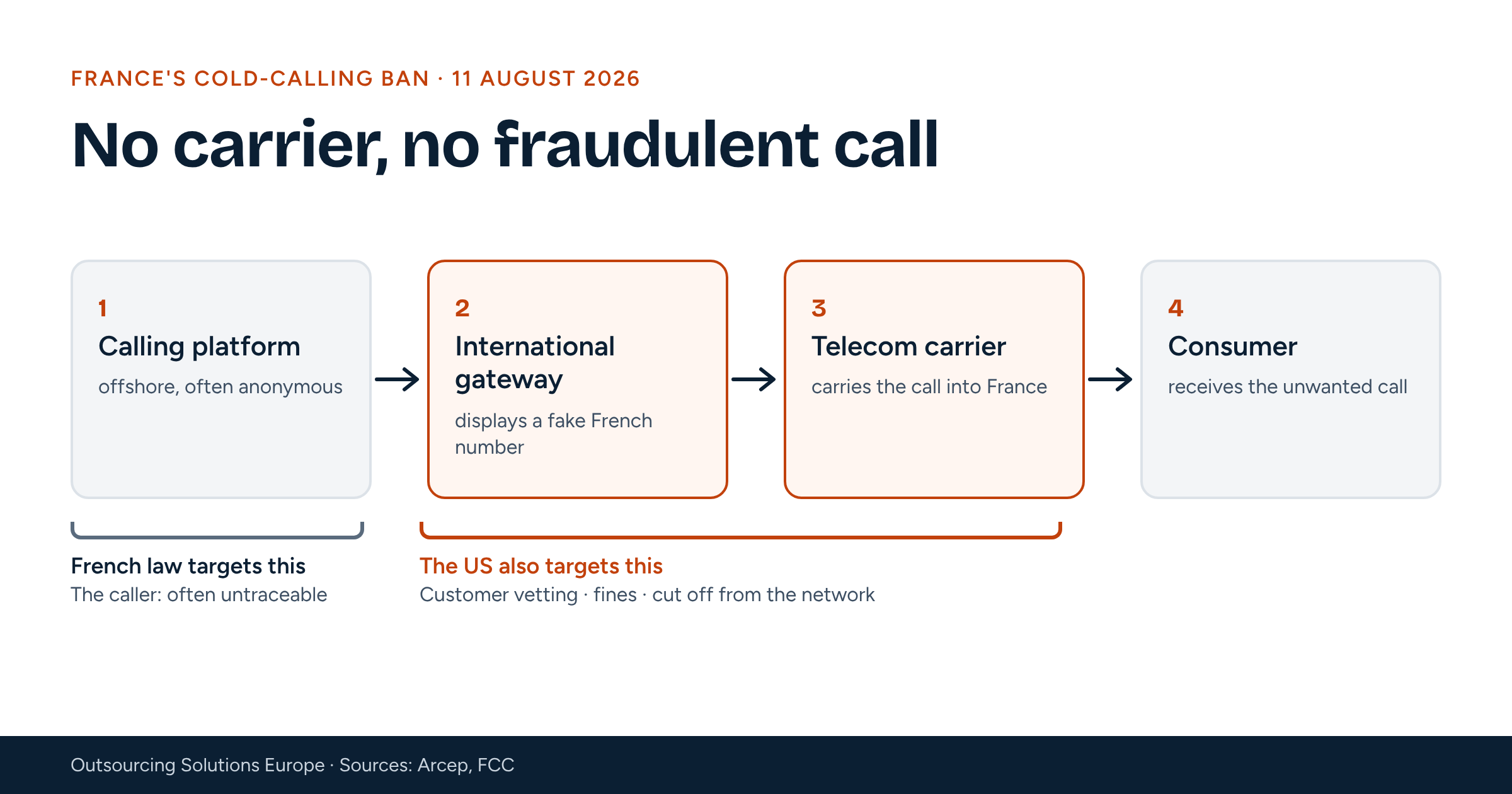
A fraudulent call always needs a carrier to reach the consumer. No phone network, no fraud. Yet in France, the law mainly targets the company that makes the calls, often untraceable abroad, and much less the operators that carry them.
The United States has taken the opposite approach: carriers are held responsible for the traffic they let through.
- Know your customer. The FCC requires voice providers to run a "Know Your Customer" programme and vet customers before carrying their calls.
- Fines for carriers that look the other way. In August 2024, carrier Lingo Telecom paid $1 million for certifying fraudulent calls without checking its customer's right to use the numbers displayed. In February 2025, the FCC proposed a $4.5 million fine against carrier Telnyx, which disputes it, for carrying scam calls without vetting new customers.
- Cutting off the network. In August 2025, the FCC removed more than 1,200 providers from its Robocall Mitigation Database. Other carriers must then refuse their traffic: they are effectively disconnected from the US phone network.
In France, Arcep has required caller authentication and the masking of fake French numbers from abroad, and opened an investigation into operators in January 2026. It is a first step. But as long as a carrier or an international gateway risks nothing by carrying millions of illegal calls, the law will mostly hit those who already comply. Making the whole telecom chain accountable, with verification duties and dissuasive penalties, would probably work better than adding more bans.
What companies outsourcing outbound calls must check
If a provider calls French consumers on your behalf, check these seven points now.
- Where consent comes from. For every contact called: where, when and how consent was given. Require time-stamped proof, kept for three years.
- Purchased lists. If your provider or a lead broker supplies the contacts, ask for proof of collection. A list without traceability is a liability, not an asset.
- The subcontracting chain. Does your provider subcontract part of the calls? To whom, and in which country? Hidden subcontracting to non-compliant platforms is the main blind spot.
- Displayed numbers. Calls must come from identifiable, authenticated numbers, never spoofed or rotating ones.
- Tool settings. Legal calling hours and the 4-calls-a-month cap must be enforced in the dialler, not just written in a procedure.
- Your audit rights. Call listening, call log extracts, unannounced visits: without direct access, you can prove nothing.
- The contract. Clear clauses on compliance, retention of proof, liability in case of penalties and immediate termination for breach. Have these reviewed by your legal counsel.
It is also the right time to rethink the set-up: call back customers who ask for it, work inbound leads and retention of existing customers, and strengthen chat and email. A call that is expected converts better than one that is endured.
In short
The 11 August 2026 law has not eliminated illegal calls; it has mostly separated providers who comply from those who work around the rules. For a brand, the issue is no longer just the cost per call, but proof of compliance across the whole chain. That is exactly what we check when we audit a provider.
Outsourcing outbound calls and want to check your compliance? Let's talk: the call is free and without commitment.
Sources (accessed 5 October 2026): DEETS La Réunion, the new rules · Hellowatt, SignalConso complaints · Labomaison, one month after the law · Enerzine, 26,000 complaints · Presse-citron, why calls persist · L'assurance en mouvement, Senate question · Arcep, press release on number spoofing · Le360, FMES figures · Le Brief, 10,000 or 50,000 jobs? · Wiley, FCC removes 1,200 providers · EPIC, proposed Telnyx fine · CommLaw Group, Lingo Telecom settlement
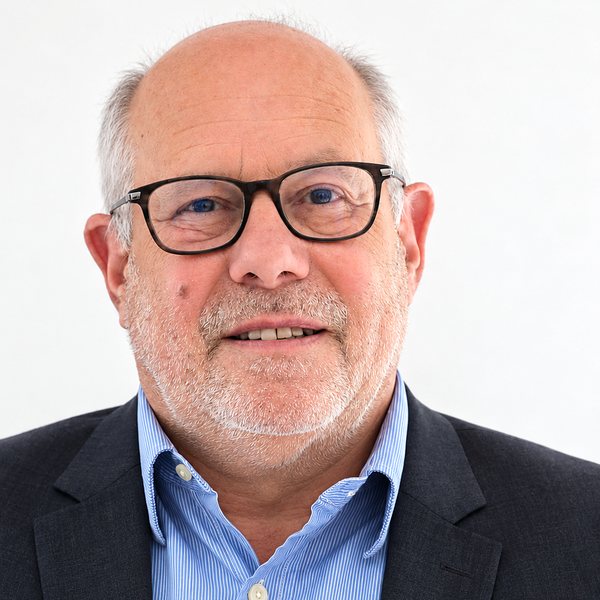
Philippe Legal, founder of Outsourcing Solutions Europe. 35 years building and running contact centers on the provider side, now advising buyers.